







- Fact Checked
- March 04, 2026
- 13 min read
Can Chlamydia Cause Infertility? Answers for Men & Women

-
Written by
Hans Graubard
• Updated on April 02, 2026

Dietary supplement manufacturing, regulatory and product development, and DTCt; leadership experience...
- Updated on April 02, 2026
Table of Contents
Table of Contents
Chlamydia has a reputation as "no big deal." Take some antibiotics, clear it up, move on. And for most people who catch it early, that's exactly how it goes. But there’s another side to chlamydia, too, and that’s this: when chlamydia goes undetected and untreated (which happens more than you think since most people have zero symptoms), it can cause permanent damage to the reproductive system.
We don’t say this to alarm you (being alarmist just isn’t our style). Instead, it's meant to help you make informed decisions about your sexual health. So let’s dive in and talk about everything you need to know about one of the most common and most underestimated causes of infertility and how to protect yourself against it.
This post is for informational purposes only and does not constitute medical advice. See full disclaimer below.
What Is Chlamydia, Exactly?
Chlamydia is the most common bacterial sexually transmitted infection (STI) in the United States.1 It's caused by Chlamydia trachomatis, a bacterium that targets the epithelial cells lining the reproductive tract (think: the cervix, uterus, fallopian tubes, and ovaries in women and the urethra and genital tract in men).
In 2022, over 1.6 million cases of chlamydia were reported to the Centers for Disease Control and Prevention (CDC), and that number likely represents a fraction of actual infections, since most people never know they're infected.2
That's the central problem: chlamydia is largely asymptomatic, so up to 70% of women and around 50% of men with a chlamydia infection experience no noticeable symptoms.3 Without symptoms that compel someone to see a doctor, the infection can linger undetected for months or even years, doing slow, silent damage to the reproductive system the entire time.
How Does Untreated Chlamydia Lead to Infertility?
Chlamydia itself doesn’t cause infertility, but complications that arise when it goes untreated can.4 Here’s how it typically goes;
Chlamydia → PID → Infertility
When it comes to chlamydia, the most significant risk for women is pelvic inflammatory disease (PID), or a serious infection of the upper reproductive tract, which includes the uterus, fallopian tubes, and ovaries.5 When chlamydia bacteria ascend from the cervix into these structures, the resulting inflammation can cause lasting structural damage, which can cause infertility.
According to the CDC, roughly 10–15% of women with untreated chlamydia will develop PID, and some research suggests the numbers may be even higher in younger women.6 One study found that chlamydia progressed to PID in approximately 35% of women aged 16–24. Once PID develops, about 20% of patients experience tubal scarring severe enough to cause infertility, 18% develop chronic pelvic pain, and 9% face an ectopic pregnancy.
The Fallopian Tube Problem
The fallopian tubes are narrow, delicate structures. When PID-related inflammation causes scarring, those tubes can become partially or fully blocked, leading to a condition called tubal factor infertility (TFI).7 A blocked fallopian tube prevents sperm from reaching an egg, or prevents a fertilized egg from traveling to the uterus.
A 14-year prospective cohort study found that women who tested positive for chlamydia had nearly three times the risk of developing tubal factor infertility compared to chlamydia-negative women.8 And another study found women with two or more chlamydia infections faced significantly higher PID risk than those with a single infection, meaning each reinfection compounds the damage.
In some cases, scarred fallopian tubes fill with fluid, creating a condition called hydrosalpinx, which can impair fertility even further and reduce the success rates of IVF.9
And all this fallopian tube damage? It can occur even when chlamydia has not resulted in PID. The infection can ascend silently into the upper genital tract with no obvious symptoms like fever or pelvic pain, while still triggering an immune response that results in scarring. This is why "unexplained infertility" is sometimes traced back to a past chlamydia infection the person never knew they had.10
Ectopic Pregnancy
PID and tubal scarring also dramatically increase the risk of ectopic pregnancy, which is when a fertilized egg implants in the fallopian tube rather than the uterus.11 Chlamydia-positive women have roughly twice the risk of ectopic pregnancy compared to chlamydia-negative women. An ectopic pregnancy cannot be carried to term and is considered a medical emergency. Depending on treatment, it can also cause further tubal damage that complicates future conception.
Again, we don’t shed light on these studies and statistics to scare you, but to help you protect your reproductive health with some science-backed strategies we’ll get into in just a bit.
What Are the Symptoms of Chlamydia (When There Are Any)?
Most people with chlamydia have no symptoms, which is what makes it so dangerous to reproductive health.12 When symptoms do appear, they tend to be mild and easy to dismiss or attribute to another common infection, often showing up one to three weeks after exposure.
In women, common symptoms may include:
- Unusual vaginal discharge (often thin, cloudy, or with an unfamiliar odor)
- Burning or painful urination
- Bleeding between periods or after sex
- Pain during sex (dyspareunia)
- Mild pelvic pain or lower abdominal discomfort
- Vaginal or cervical tenderness
In men, symptoms may include:
- Discharge from the penis (watery or milky)
- Burning or stinging during urination
- Swelling or tenderness in one or both testicles
- Discomfort around the urethra
These symptoms overlap significantly with other common conditions , like yeast infections, bacterial vaginosis, and UTIs, so many people (and especially women with a history of BV or yeast infections) brush them off or treat what they assume is a different issue, without actually addressing the root cause.13
When Chlamydia Becomes PID
Even if chlamydia is silent initially, once it advances to PID, the symptoms tend to escalate.14 Though again, sometimes PID is asymptomatic as well.
When PID does produce symptoms, they can include:
- Persistent or worsening pelvic or lower abdominal pain
- Pain deep in the pelvis during sex
- Fever (sometimes accompanied by chills)
- Nausea or vomiting in more severe cases
- Heavier or more painful periods
- Unusual vaginal discharge that may have a strong odor
Like the initial chlamydia infection, PID shares symptoms with other ailments, like appendicitis, ovarian cysts, and endometriosis. That’s why it's frequently misdiagnosed on the first clinical visit.
That’s also why it’s important to be open and honest with your doctor about your sexual health history, especially if you have pelvic pain, giving them an honest account of your STI history and any unprotected sex.15 Though it can be uncomfortable, this honesty will ultimately get you the correct diagnosis.
How Chlamydia and PID Are Diagnosed
Chlamydia is diagnosed through what’s called a nucleic acid amplification test (NAAT). This test detects a bacterium's genetic material and is considered highly accurate.16 Testing is relatively non-invasive and can be done via a urine sample, a self-collected vaginal swab, or a cervical swab taken by a clinician. At-home test kits are also widely available and increasingly reliable (though the most reliable route will always be your doctor).
As for PID, there's no single definitive test to diagnose it. Diagnosis is typically clinical, meaning your provider pieces together your symptoms, any pelvic exam findings (such as cervical tenderness or adnexal tenderness on touch), and lab results.17 A pelvic ultrasound may also be ordered to look for enlarged fallopian tubes or abscesses. In ambiguous cases, a laparoscopy (which is a minimally invasive surgical procedure) allows direct visualization of the pelvic organs and is the most definitive diagnostic method, though it's not used routinely.
For women with a history of chlamydia who are now experiencing fertility challenges, a chlamydial antibody titer (CAT) blood test can indicate past infection, even if it's no longer active.18 More definitive evaluation of tubal patency (aka whether the fallopian tubes are open) can be done through hysterosalpingography (HSG) or hysterosalpingo foam sonography (HyFoSy), which are imaging procedures that trace whether fluid can pass freely through the tubes.
If you've ever had chlamydia, gonorrhea, or PID, and you're now trying to conceive without success, ask your provider specifically about tubal factor infertility workup.19 It's not always offered automatically but may help provide answers.
Can Chlamydia Cause Infertility in Men?
This is a question that doesn't get nearly enough attention. Yes, chlamydia can affect male fertility, though the science is more nuanced than on the female side.20
Epididymitis and Scarring
In men, untreated chlamydia can travel from the urethra to the epididymis, or the tightly coiled tube behind the testicles where sperm matures.21 This causes epididymitis, an inflammation that can result in scarring and blockages in the tubes responsible for transporting sperm.
Chlamydia is responsible for anywhere from 40–80% of epididymitis cases. In more severe or chronic cases, epididymitis can lead to reduced sperm concentration, obstruction, and, in some instances, long-term impairment of fertility.22
DNA Damage in Sperm
Research also suggests chlamydia can directly damage sperm quality.23 Studies have found significantly elevated rates of sperm DNA fragmentation in men with chlamydia infections compared to uninfected controls. In some studies, this risk is as much as three times higher. Sperm with fragmented DNA are less capable of fertilizing an egg and, when fertilization does occur, may result in poor embryo development.
Additional parameters (think: sperm motility, morphology, and concentration) have also been found to be impaired in some chlamydia-infected men, though findings across studies are mixed.24
The good news is the impact of chlamydia on male fertility appears to be less severe and more reversible than in women, especially when treated promptly with antibiotics.25 One study found that after antibiotic treatment, sperm DNA fragmentation improved significantly and pregnancy rates increased substantially.
Do Other STIs Cause Infertility Too?
Chlamydia gets a lot of the attention for this reason, but it's not the only STI that can quietly wreak havoc on your reproductive health.26 Gonorrhea is right there with it. It’s a leading cause of PID and tubal factor infertility in women and epididymitis in men, and is currently the second most commonly reported STI in the U.S. The two infections frequently show up together, which means the damage to reproductive organs can compound fast.
Syphilis is another STI worth knowing about. It's been rising steadily in the U.S. and can affect reproductive health when it goes untreated.27 Even HPV has been linked to reduced sperm motility and DNA fragmentation in some research.
The biggest takeaway here: any sexually transmitted disease that causes inflammation in the genital tract has the potential to create fertility complications, whether that's primary infertility (never having conceived) or secondary infertility (struggling to conceive after a previous pregnancy). Chlamydia and gonorrhea are the most well-documented culprits, but luckily, also the most preventable.
How Long Does It Take for Chlamydia to Cause Infertility?
There's no single answer to this question. The timeline depends on several factors, including how long the infection goes untreated, whether it ascends to the upper reproductive tract, how many reinfections occur, and individual immune response.28
Some research suggests that PID can develop within weeks of initial infection, particularly in younger women.29 Fallopian tube damage, however, tends to be cumulative, meaning each episode of PID, whether clinically recognized or "silent", adds to the scarring burden. This is why repeated infections carry exponentially higher risk.
Age also matters here: women under 20 at the time of first infection appear to face higher long-term risk than older women.
The unsettling reality is that many people don't discover fertility complications from past chlamydia infections until they're actively trying to conceive, sometimes years later.
Is Infertility from Chlamydia Reversible?
It depends on the extent of the damage.
Chlamydia itself is curable. A course of antibiotics (typically doxycycline or azithromycin) clears the infection, and early treatment before PID develops can prevent infertility entirely.
Structural damage is a different story. Scarring and blockages in the fallopian tubes cannot be reversed by antibiotics. In cases of mild to moderate tubal damage, surgical intervention may restore some function. In cases of severe or complete blockage, IVF is typically the most effective path to pregnancy, as it bypasses the fallopian tubes entirely.30
For women with a history of chlamydia or PID who are having difficulty conceiving, a fertility specialist can evaluate tubal patency through imaging or laparoscopy and recommend appropriate treatment options.31
Chlamydia Screening and Prevention
Because chlamydia is often asymptomatic, regular screening is the only reliable way to catch it early. The CDC recommends:
- Annual chlamydia and gonorrhea screening for all sexually active women under 25
- Annual STI testing for older women with risk factors, including new or multiple sexual partners, or a sex partner with a known STI
- STD testing for all pregnant women at the first prenatal visit
- Partner testing and treatment whenever a chlamydia diagnosis is made, to prevent reinfection
We cannot emphasize this enough: early detection is everything. Catching a chlamydia infection before it ascends into the upper reproductive tract can completely prevent PID, which prevents all the fertility issues that can follow. If you're sexually active and not in a mutually monogamous relationship with a tested partner, regular STI testing is one of the most important things you can do for your sexual health and long-term fertility. These tests are quick, minimally invasive, and increasingly available through at-home options, meaning you don’t even have to leave your house to stay informed.
Other key prevention strategies include:
- Consistent and correct use of condoms during vaginal, anal, and oral sex
- Open, honest conversations with sexual partners about STI status and testing history
- Seeking treatment promptly if you test positive and notifying partners so they can be tested and treated too
- Avoiding reinfection by ensuring all partners are treated before resuming sexual activity
- Being aware that increased risk comes with unprotected sex and multiple sex partners, and adjusting screening frequency accordingly
One more thing worth mentioning: keeping your vaginal microbiome healthy is part of the picture here, too. When your microbiome is balanced (which typically means having enough levels of protective Lactobacillus probiotics), your body is better equipped to fend off the kind of disruption that lets infections like chlamydia take hold in the first place.
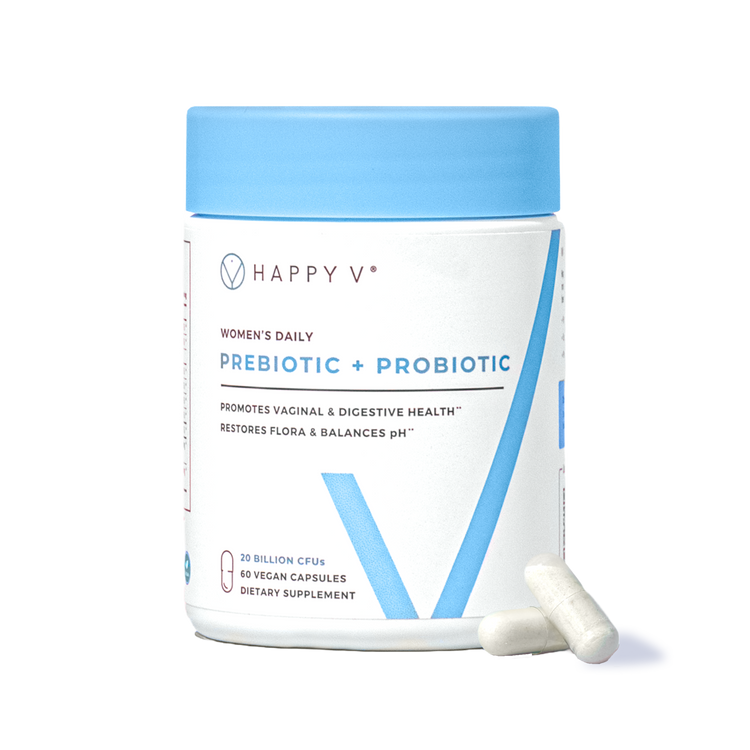
Happy V's Prebiotic + Probiotic was doctor-formulated with microbiome balance in mind, and aside from annual screenings, are one of the easiest additions you can make to your routine to protect your long-term reproductive health.
 Bestseller
Prebiotic + Probiotic
Maintains vaginal pH and restores gut health.
The Bottom Line
Can chlamydia cause infertility? Yes, and it does so silently when left untreated, in both men and women.
If you're sexually active, get tested regularly, especially if you're under 25, have multiple sexual partners, or have had unprotected sex. If you've had cases of chlamydia in the past and are now trying to conceive, talk to your doctor about evaluating your reproductive health. Early detection is everything, both for protecting your fertility now and keeping your options open for the future.
Keep the Conversation Going
- Visit our blog for more women's health tips.
- Join our private Happy V Facebook group to hear from others who've been there.
- Explore supplements designed to support your vaginal health journey.
Disclaimer: This blog is for informational and educational purposes only and is not intended to diagnose, treat, cure, or prevent any disease. Statements about supplements have not been evaluated by the Food and Drug Administration. For more information about vaginal infections, visit the CDC or speak to a licensed healthcare provider.