



- Fact Checked
- October 02, 2026
- 19 min read
Are There Probiotics That Help Reduce UTI Recurrence?

- Written by Daniella Levy • Updated on October 02, 2026
- Updated on October 02, 2026

Table of Contents
Table of Contents
Chances are, if you’re reading this article, this routine sounds familiar: you go to the bathroom and feel that tell-tale burning sensation. So you do the responsible thing, call your doctor, get antibiotics, and take them exactly as prescribed. You feel better for a few weeks. But then… it starts all over again.
Urinary tract infections (UTIs) that occur three or more times in a 12-month period are known as recurrent UTIs, and for decades, the standard answer was simply more antibiotics.
But research has changed how experts think about bladder infections. Your bladder isn't sterile. It has its own urinary microbiome, and it's closely connected to the vaginal microbiome just a few centimeters away. When beneficial Lactobacillus bacteria dominate both, they form a natural first line of defense against the bacteria that cause infections like urinary tract infections. When those protective bacteria are wiped out (often by the same antibiotics used to treat each UTI), it actually opens the door for recurrence.
Given the importance of Lactobacillus in the urinary and vaginal biome, more women are asking whether Lactobacillus-based probiotics can help break the recurrent UTI cycle. The short answer is yes. The longer answer is yes, but only if it contains the right strains because not all Lactobacillus strains have been shown to have health benefits.
This post is for informational purposes only and does not constitute medical advice. See full disclaimer below.
What Is a Recurrent UTI?
To understand how probiotics can play a role in UTI prevention, it helps to understand what a UTI actually is and why it can keep coming back.
A urinary tract infection (UTI) happens when bacteria enter the urethra and multiply somewhere in the urinary tract. Most UTIs stay in the bladder, causing an infection called cystitis, but if left untreated, the bacteria can travel up the ureters into the kidneys. So even though UTIs are incredibly common, they should also not be dismissed or ignored.
Recurrent urinary tract infections are typically defined as two or more culture-confirmed infections in six months, or three or more in a year. That definition comes from clinical guidelines, including those from the American Urological Association.
If you’re experiencing recurrent UTIs, you aren’t alone. About half of all women will have at least one UTI in their lifetime, and roughly one in four will have another within six months. Frequent UTIs are especially common in sexually active women and post-menopausal women.
Common UTI symptoms
UTIs are usually pretty hard to miss, with accompanying symptoms like:
- Dysuria (burning or pain when you pee)
- Frequent urination or a strong, persistent urge to go
- Cloudy or strong-smelling urine
- Pelvic pressure or lower abdominal discomfort
- Hematuria (blood in your urine)
Though noticeable, these symptoms are not unique to UTIs. They are also seen in other conditions like overactive bladder, interstitial cystitis, or vaginal infections like BV. This is also why it’s important to be seen by a doctor sooner than later. Not only do you want to treat an active UTI quickly, but you want to be sure you have a UTI in the first place and don’t try to treat the wrong infection.
Common Causes and Risk Factors for Recurrent UTIs
Escherichia coli (E. coli) causes the vast majority of bladder infections. It normally lives harmlessly in your gut, but it can cause trouble when it travels from the rectal area to the vaginal opening and into the urethra.
Risk factors are what make that journey easier, whether by moving bacteria closer to the urethra, weakening your natural defenses, or giving bacteria a place to settle. Most recurrent UTIs come from a mix of behavioral, hormonal, and anatomical factors, and knowing which apply to you is the first step toward drafting the right prevention strategy.
Here are the most common risk factors that make it easier for bacteria to enter and grow in your urinary tract:
Frequent sexual activity
Sexual intercourse is one of the strongest risk factors for recurrent UTIs in premenopausal women. Friction during sexual activity can push bacteria toward the urethra. Frequent sexual activity, a new partner, and spermicides all raise risk. Spermicides are especially worth knowing about, because they kill protective Lactobacillus and make it easier for E. coli to take hold.
Hormonal Changes and Menopause
Hormonal changes throughout your life affect your urinary health. As estrogen levels drop during perimenopause and menopause, vaginal tissue thins and produces less glycogen, which is a sugar that Lactobacillus feeds on. With less lactobacilli, vaginal pH rises and less desirable bacteria, like E. coli, have more opportunity to grow. This is a major reason recurrent UTIs become more common after menopause.
Incomplete Bladder Emptying
When your bladder doesn't empty fully, leftover urine gives bacteria time and space to multiply. Incomplete bladder emptying can be caused by pelvic organ prolapse, urinary incontinence, nerve conditions, or habits like regularly holding urine for long stretches.
Diabetes and Immune System Function
Diabetes raises UTI risk in two ways. First, glucose in urine can feed bacteria. Second, diabetes can affect immune system function, making it harder for your body to clear bacterial infections. Other conditions or medications that weaken immune function can have a similar effect.
Hygiene Habits and Irritating Products
Poor hygiene habits, like wiping back to front as opposed to front to back, can move bacteria closer to the urethra. But overcleaning causes problems too. The use of irritating products and practices, including douching, scented washes, and harsh feminine hygiene products, strips away beneficial bacteria and disrupts your natural pH. If you want to feel fresh, a gentle, pH-balanced cleanser like Happy V's Feminine Wash, used only on the external vulva, supports your body instead of fighting it.
Antibiotics and Bacterial Resistance
Antibiotics are essential for treating UTIs, but each course also disrupts the vaginal and urinary microbiome by killing off Lactobacillus along with the bad bacteria. Repeated courses also fuel bacterial resistance, which means future infections may be harder to treat. Antibiotic resistance is now one of the biggest concerns in managing recurrent UTIs, and it's a key reason researchers are looking hard at probiotics.
The Role of the Vaginal Microbiome in UTI Prevention
It might seem strange to talk about your vagina in an article about bladder infections, but most UTIs don't start in the bladder. They start next door.
Before E. coli ever reaches your urethra, it usually has to take up residence around the vaginal opening first. Researchers have actually found that women who get recurrent UTIs are more likely to have E. coli colonizing the vaginal opening, which gives bacteria a staging ground just a short trip from the urethra.
That makes your vaginal microbiome one of your most important defenses against UTIs. When it's healthy, it's dominated by Lactobacillus species, which make the area inhospitable to E. coli before it can get a foothold. Researchers now know the urinary microbiome contains Lactobacillus too, so that protection may extend into the bladder itself.
When your microbiomes are not dominated by Lactobacillus, the door opens for infection. And having one infection can raise your risk for another. Take bacterial vaginosis (BV), for example. BV is a vaginal infection caused by a depletion of Lactobacillus and an overgrowth of other bacteria (typically Gardnerella vaginalis), and having it can actually raise your risk of UTIs!
This is exactly why certain Lactobacillus-based probiotics can be so helpful. Instead of chasing each infection after it starts, the right strains help rebuild the defenses that stop E. coli from gaining a foothold in the first place.
The Best Probiotic Strains for UTI Recurrence
For a probiotic to provide any sort of defense against UTI recurrence, it needs to have Lactobacillus strains. And not just any strains, either. There are hundreds of different strains of Lactobacillus, and only a handful of them have been shown to have any benefits on vaginal and urinary tract health.
Here’s what to look for on a probiotic label if UTI recurrence is a priority:
Lactobacillus crispatus (CCFM1110™)
Lactobacillus crispatus is often the dominant species in a healthy vaginal microbiome, and it's considered one of the most protective members of the lactobacilli family. It's a powerhouse of lactic acid production, keeping vaginal pH low enough that E. coli and other uropathogens struggle to survive. Research consistently links L. crispatus dominance to lower rates of both bacterial vaginosis and recurrent UTIs, and it's one of the most studied species for UTI prevention. Get to know it better in Lactobacillus Crispatus: The Best Probiotic for Women's Vaginal Health.
.
Lactobacillus rhamnosus (HN001™) and Lactobacillus reuteri (HR7™)
Lactobacillus rhamnosus and Lactobacillus reuteri are two of the most researched species in women's urogenital health. L. rhamnosus is known for its ability to survive digestion and adhere to tissue, helping it hold ground against pathogens. L. reuteri produces antimicrobial compounds, including a substance called reuterin, that help keep harmful bacteria in check. HN001 in particular has been studied for its ability to reach the vaginal area when taken orally, a key step for an oral probiotic to support urinary health.
Lactobacillus gasseri (HLG13™)
Lactobacillus gasseri is another species naturally found in a healthy vaginal microbiome, where it's one of the few Lactobacilli that commonly dominate. Like L. crispatus, it contributes to lactic acid production and helps maintain an acidic environment that discourages uropathogens from settling in.
Lactobacillus acidophilus (LA-14®)
Lactobacillus acidophilus is one of the best-known probiotic species, and LA-14 is a well-characterized strain. It produces lactic acid and supports microbial balance in the gut, which matters because the gut is where E. coli lives before it ever reaches the urinary tract. LA-14 has also been studied alongside L. rhamnosus HN001 for its ability to reach the vaginal area after oral use.
Why strain selection matters more than strain count
A probiotic with 30 strains and 100 billion CFUs sounds impressive, but more isn't automatically better. Many broad-spectrum formulas are designed for general gut health and include strains with no connection to the vaginal and urinary tract microbiome. Strain-specific probiotics, chosen because each strain has a role in urogenital health, are a smarter bet than the longest ingredient list.
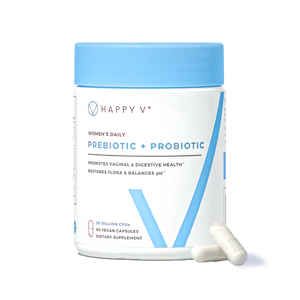
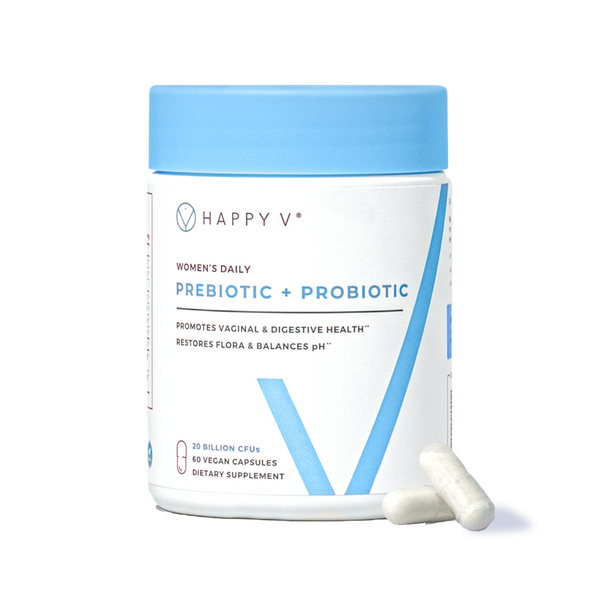
That's the thinking behind Happy V's Prebiotic + Probiotic. With 20 billion CFUs across seven targeted strains, plus PreforPro to support the growth of beneficial bacteria, it's formulated specifically for vaginal and urinary health.
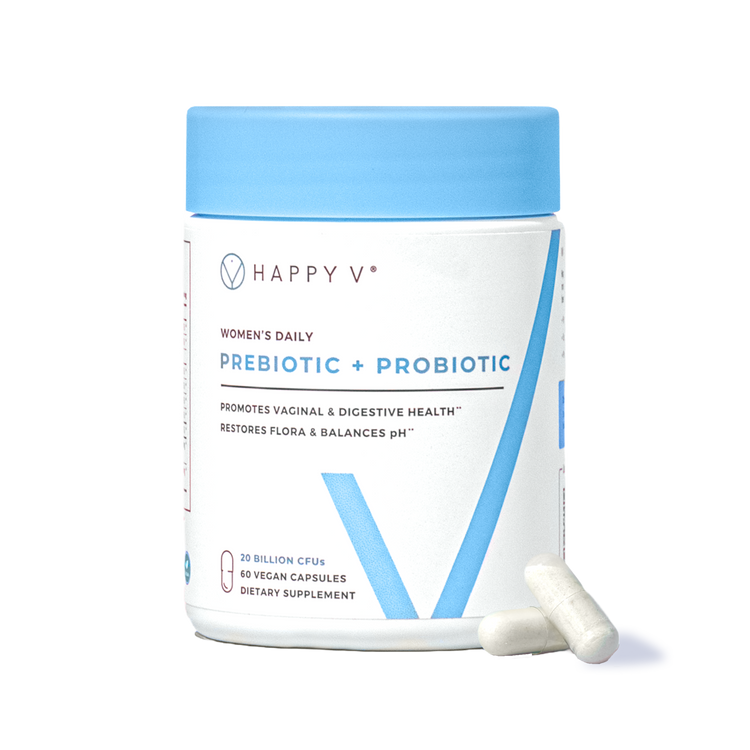 Bestseller
Prebiotic + Probiotic
Maintains vaginal pH and restores gut health.
Clinical Evidence: Do They Actually Work?
The honest answer: the evidence is promising, strain-dependent, and still evolving.
Summary of Key Studies
A review in the National Library of Medicine found that results vary widely depending on the probiotic strains, dose, and delivery method studied. Here's what randomized trials show so far:
- Vaginal probiotics: L. crispatus CTV-05 suppositories significantly reduced recurrence in premenopausal women with a history of recurrent UTIs.
- Oral probiotics: L. rhamnosus GR-1 and L. reuteri RC-14 reduced infections in post-menopausal women, though slightly less effectively than antibiotics. Importantly, they didn't drive antibiotic resistance.
- Mixed or generic probiotics: When a meta-analysis pools studies using many different strains and products, benefits tend to look smaller or inconclusive.
Why results vary
That last point explains a lot of confusing headlines. Studies differ in which strains they test, how much they use, how long they last, and who participates. A probiotic supplement with untested strains is unlikely to perform like the clinically studied strains in the best trials. Researchers are continuing to investigate, including in ongoing clinical trials. For now, probiotics are best seen as a way to restore microbial balance and support your immune response, not a replacement for medical care. For a deeper dive, read our guide on whether probiotics can help prevent UTIs.
Probiotics for Postmenopausal Women
Post-menopausal women face a unique set of challenges, including increased risk for UTIs. Estrogen loss reduces vaginal Lactobacillus, raises vaginal pH, and changes the vaginal flora and urinary microbiome in ways that make it easier for uropathogens to thrive.
In one of the most important studies in post-menopausal women, researchers compared a daily probiotic (L. rhamnosus GR-1 and L. reuteri RC-14) to a daily low-dose antibiotic taken to prevent UTIs. After a year, the antibiotic prevented slightly more infections, but the probiotic came close. The bigger difference showed up in the bacteria themselves. Women taking the antibiotic developed high rates of antibiotic resistance, meaning future infections could be harder to treat. Women taking the probiotic didn't.
In other words, the probiotic offered nearly as much protection without the long-term cost. That's a meaningful tradeoff if you're facing years of prevention and want to keep antibiotics working for when you really need them.
For many post-menopausal women, the most effective approach against recurrent UTIs combines probiotics with vaginal estrogen therapy. Low-dose vaginal estrogen helps restore healthy tissue and the glycogen Lactobacillus needs, lowering vaginal pH and making room for beneficial bacteria. Ask your doctor whether this combination makes sense for you.
How to Choose and Use a Probiotic for UTIs
Not all probiotic supplements are created equal, and the label doesn't always make the differences obvious. Here's what to look for so you can choose a probiotic that's actually built for vaginal and urinary health, and use it in a way that gives it the best chance to work.
CFU Count: How Much Is Enough?
Colony forming units (CFUs) measure the number of live bacteria in each dose. Clinical trials on urogenital strains have commonly used around 1 billion CFUs or more per day. Getting the right probiotic strains at a researched dose matter more than chasing the highest number.
Delivery Methods: Oral vs. Suppository
Quality probiotics can come in two forms. Which you choose often comes down to a matter of personal preference.
- Oral probiotics are easy to take daily. They work through the gut-vagina axis: beneficial bacteria pass through your digestive tract and can migrate to the vaginal area, supporting both the urinary and vaginal microbiome.
- Vaginal probiotics, usually vaginal suppositories, deliver bacteria like Lactobacillus crispatus directly where they're needed. They can quickly boost lactic acid and antimicrobial compounds, helping lower vaginal pH. The tradeoff is convenience, since they're less widely available and harder to use long term.
Both approaches can help prevent recurrent UTIs and bacterial vaginosis. For most women, a daily oral probiotic is the easiest to stick with, and consistency is what matters most.
Look for Prebiotics
Prebiotics are fibers that feed beneficial bacteria. Common ones include inulin and fructooligosaccharide. A formula that pairs prebiotics with probiotics can help good bacteria establish themselves more effectively.
Check quality
Supplements aren't regulated like medications, so quality varies. Look for:
- A reputable manufacturer with transparent sourcing
- Third-party testing for potency and purity
- Specific strain names, not just species
- Clear label instructions for dosage and storage
When in doubt, ask for healthcare provider guidance, especially if you have a health condition or take other medications.
Why Happy V Checks Every Box
When you put all of these criteria together, the list of probiotics that actually qualify gets short fast. Happy V's Prebiotic + Probiotic was built to meet every one of them, with:
- The right strains: Seven targeted strains chosen for vaginal and urinary health, including Lactobacillus crispatus, Lactobacillus rhamnosus, Lactobacillus reuteri, and Lactobacillus gasseri, the species that naturally protect a healthy urogenital microbiome. Every strain is listed by name on the label, so you know exactly what you're getting.
- Research-backed doses: 20 billion CFUs per serving, with each strain delivered at 1 billion CFUs or more, in line with the doses used in clinical research on urogenital probiotics.
- A smarter prebiotic: Instead of relying only on fibers like inulin, the formula includes PreforPro, a bacteriophage prebiotic that targets certain E. coli strains in the gut and helps beneficial bacteria flourish.
- Made in Happy V's own facility: Happy V owns its manufacturing facility, so every step is under its control. Ingredients come from vetted suppliers and are tested for purity and contaminants in an on-site microlab, following FDA and cGMP guidelines. QA technicians check each batch at multiple quality checkpoints before it ships.
- Built to survive digestion: Acid-resistant vegetable capsules help protect live bacteria from stomach acid so more of them reach your gut.
- Expert-formulated: Developed by a team of biochemists and formulators, with guidance from a medical advisory board that includes a board-certified OB-GYN.
- Easy to stick with: One daily capsule, so consistency, the factor that matters most, fits into your routine.
If you're looking for a probiotic designed specifically to support your vaginal and urinary health, Happy V's Prebiotic + Probiotic is a simple place to start.
Other Ways to Reduce UTI Risk
Probiotics work best as part of a bigger picture. These habits can help support a healthy microbiome by mitigating some of the most common risk factors. They are also all things you can implement today:
Stay hydrated
Hydration is one of the simplest, best-supported strategies. In one study, premenopausal women with recurrent UTIs who drank about 1.5 extra liters of water a day had roughly half as many infections. Staying hydrated helps you urinate more often, flushing bacteria before they can settle in.
Urinate after intercourse
Urinating after intercourse can help flush bacteria away from the urethra. The evidence is limited, but it's easy and low-risk.
Eat a well-balanced diet
A well-balanced diet built around fruits, vegetables, whole grains, and lean protein supports your immune system and gut microbiome. Fermented foods like kefir, sauerkraut, and kimchi add beneficial bacteria to your diet, though they don't replace a targeted probiotic.
Limit bladder irritants
Bladder irritants like caffeine, alcohol, carbonated drinks, artificial sweeteners, and spicy foods don't cause infections, but they can worsen urgency and discomfort, especially if you already have urinary incontinence or overactive bladder.
Choose gentle feminine hygiene products
Skip douching and scented feminine hygiene products. Reconsider spermicides if you get frequent UTIs. Wipe front to back.
Consider cranberry and D-mannose
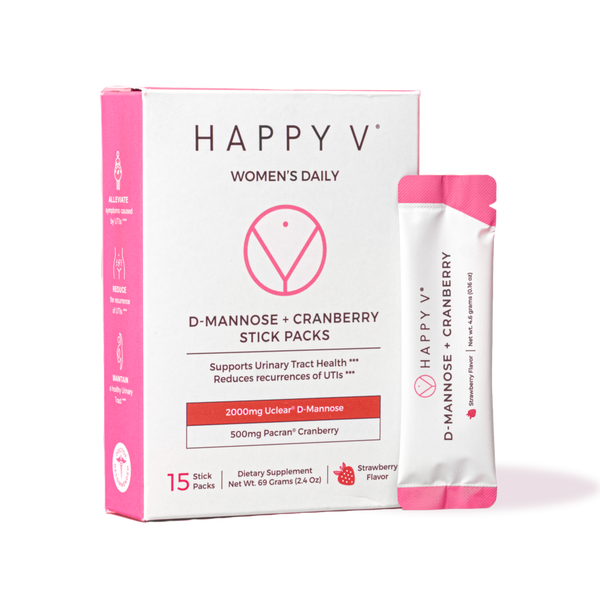
Along with probiotics, D-mannose + Cranberry supplements can be helpful in supporting urinary health, especially if you have a history of UTIs.
Cranberry contains proanthocyanidins (PACs), compounds that help keep E. coli from sticking to the bladder wall. D-mannose, a simple sugar, may bind to E. coli so it's flushed out when you pee instead of attaching to your bladder. When combined, these ingredients tackle UTI prevention from a different angle than probiotics, and many women find them complimentary.
You can read more about cranberry in Does Drinking Cranberry Juice Help for UTIs? and D-mannose in D-Mannose for UTI: Prevention and Treatment Guide.
Talk to your doctor about medical prevention
If habits and probiotics aren't enough, your doctor may recommend:
- Vaginal estrogen therapy for post-menopausal women
- Methenamine, a non-antibiotic medication that makes urine inhospitable to bacteria and has performed about as well as low-dose antibiotics in trial
- Low-dose antibiotics, taken daily or after sexual activity, for women with very frequent infections
And when an infection does happen, targeted antibiotic treatment based on your urine culture, rather than a guess, gives you the best chance of clearing it. First-line options often include nitrofurantoin and trimethoprim/sulfamethoxazole, depending on local resistance patterns.
If you have immune system suppression from a medical condition or medication, work closely with your doctor, since you may need a more tailored plan.
Probiotics as Treatment vs. Prevention
For as much as we’ve been talking about probiotics and how they can play a role in UTI prevention, it’s important to make the distinction that prevention is not the same as treatment.
If you have UTI symptoms right now, you need a diagnosis and likely a course of antibiotics. Probiotics can't clear an infection that's already established, and waiting to see if they work can allow bacteria to spread to your kidneys.
Here is where probiotics best fit into a UTI care plan:
- During antibiotics: Taking probiotic supplements a few hours apart from your antibiotic dose may help protect beneficial bacteria.
- After antibiotics: Continuing probiotics helps rebuild the vaginal microbiome, lowering your risk of both recurrent UTIs and bacterial vaginosis.
- Long term: As a form of nonantibiotic prophylaxis, probiotics help keep resistant bacteria and other uropathogens from gaining ground.
Probiotics support your defenses rather than replace treatment. And while they are considered safe for most people, it’s smart to talk to your doctor before starting any new supplement, especially if you’re immunocompromised or take other medications for chronic conditions.
When to See a Specialist
Talk to your primary care provider or OB-GYN if you've had two or more UTIs in six months or three in a year. While a urinalysis can screen for infection, with recurrent UTIs, you should pursue a urine culture, which helps identify the exact bacteria causing the infection and the antibiotics that will be most effective against it.
Ask about a referral to urology if you have:
- Infections that return within weeks of treatment
- Hematuria that continues after an infection clears
- A history of kidney stones
- Symptoms that continue even when cultures are negative
- Urinary incontinence or incomplete bladder emptying
A urology specialist may recommend imaging or a cystoscopy, a procedure that uses a small camera to look inside your bladder, to check for stones, structural problems, or other causes of cystitis.
Red Flags That Need Immediate Care
Get medical care right away if you have:
- Fever or chills
- Pain in your back or side, below the ribs
- Nausea or vomiting
- Confusion, rapid heartbeat, or feeling very unwell
These can be signs of a kidney infection or sepsis, a life-threatening response to infection. Probiotics and home remedies are not appropriate for these symptoms.
The Bottom Line
Recurrent UTIs aren't something you just have to live with. Understanding your risk factors, getting a urine culture with each infection, and building a prevention plan with your doctor can help break the cycle.
Strain-specific probiotics, especially formulas that contain Lactobacillus crispatus, L. rhamnosus GR-1, and L. reuteri RC-14, can restore the protective bacteria that antibiotics strip away. Used consistently alongside smart habits and medical guidance, they give your body a stronger first line of defense.
Keep the Conversation Going
- Visit our blog for more women's health tips.
- Join our private Happy V Facebook group to hear from others who've been there.
- Explore supplements designed to support your vaginal health journey.
Disclaimer: This blog is for informational and educational purposes only and is not intended to diagnose, treat, cure, or prevent any disease. Statements about supplements have not been evaluated by the Food and Drug Administration. For more information about vaginal infections, visit the CDC or speak to a licensed healthcare provider.
FAQ
Which specific probiotic strain is best for UTIs?
Can I take probiotics while on antibiotics for a UTI?
How long does it take for probiotics to start preventing UTIs?
Are oral probiotics as effective as vaginal suppositories?
Does Greek yogurt help with UTIs?
Our experts continually monitor the health and wellness space, and we update our articles when new information becomes available.
- Published on: October 02, 2026
- Last updates: October 02, 2026
Written by Daniella Levy
Edited by Liz Breen