


- Fact Checked
- August 28, 2026
- 9 min read
Wellness Unfiltered with Lenia Lopez, RD: What Actually Makes a Science-Backed Supplement?

- Written by Daniella Levy • Updated on August 28, 2026
- Updated on August 28, 2026

Table of Contents
Table of Contents
Every supplement promises results. But what most people don't see is everything that happens before a product ever reaches the shelf.
For this edition of Wellness Unfiltered, we're introducing you to someone who plays a critical role behind the scenes at Happy V: Lenia Lopez, RD, our Registered Dietitian. Lenia helps evaluate the research behind every ingredient, reviews manufacturing and quality documentation, and works alongside our product development team to help ensure every Happy V formula meets the standards we'd expect for ourselves and our community.
In this conversation, Lenia explains what actually makes a supplement science-backed, the biggest misconceptions she sees in the supplement industry, what women should look for on a supplement label, and how Happy V approaches product development from research to reality.
This post is for informational purposes only and does not constitute medical advice. See full disclaimer below.
10 Questions for Lenia Lopez, RD

Many people don't realize how much research goes into developing a supplement. Can you walk us through what your role at Happy V actually entails and how you help ensure our products are both effective and trustworthy?
L: Product development at Happy V involves every department. It starts with market research, confirming there's a real need for the product, that it's commercially viable, and that we can realistically formulate it.
From there, my role is to validate the science. I review the peer-reviewed literature on each ingredient to confirm we're using the studied form at the studied dose, and that it can safely be used at that level. I also request all technical documents from our ingredient suppliers and check for things like GRAS status, certificate of analysis with microbial testing, stability data, and allergen statements, so we know that what we're receiving is safe and up to our quality standard.
All this information is what I use to ensure every claim on the product’s label is both adequately substantiated and compliant with dietary regulations.
What initially drew you to the intersection of nutrition, science, and women's health?
L: It started with gut health, which is a major area of interest for me. The gut is not an isolated system and its job goes far beyond digestion. It plays a role in immune function, mood, skin, hormones, and vaginal health, and once you understand the gut-vaginal axis, gut health and women's health stop looking like separate topics.
Why is transparency in supplement manufacturing so important, especially in an industry that can sometimes feel overwhelming for consumers?

L: Transparency is really how a dietary supplement brand proves it isn't cutting corners. People deserve to make an informed decision about what they're taking, and transparency is what makes that possible. Full ingredient and dosage disclosure instead of proprietary blends, third-party testing, cGMP-certified manufacturing, providing COAs upon request; these are the practices that help earn trust from consumers. Even though most people won't think to look closer at some of these things, the option to check should always be there.
When someone picks up a supplement bottle, what are some things they should look for on the label to help determine whether it's a high-quality product?
L: A quality supplement label should make it easy to answer whether the product is supported by scientific evidence, and whether there's enough transparency for a consumer to make an informed decision.
One of the first things I recommend checking is the ingredient list. If you see a proprietary blend without individual ingredient amounts, that's an issue because you can't evaluate a dose if you don’t know what it is. It's equally important that the amount of each ingredient matches what has been studied in clinical research. Many products include well-known ingredients but use doses that fall below what was shown to be effective.
For probiotics specifically, you want the full strain designation listed, not just genus and species. For example, “Lactobacillus acidophilus LA-14,” not just “Lactobacillus acidophilus.” A benefit shown for one strain doesn't automatically apply to another with the same species name. Also, the CFU count should be guaranteed through the product's expiration date, not just at the time it was manufactured, since microbe viability naturally drops over time.
Finally, look for signs of quality assurance, like reputable third-party certification seals or testing for the finished product.
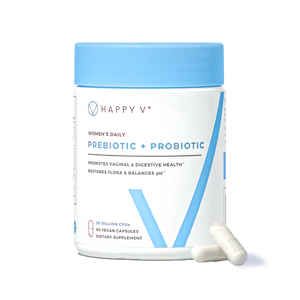
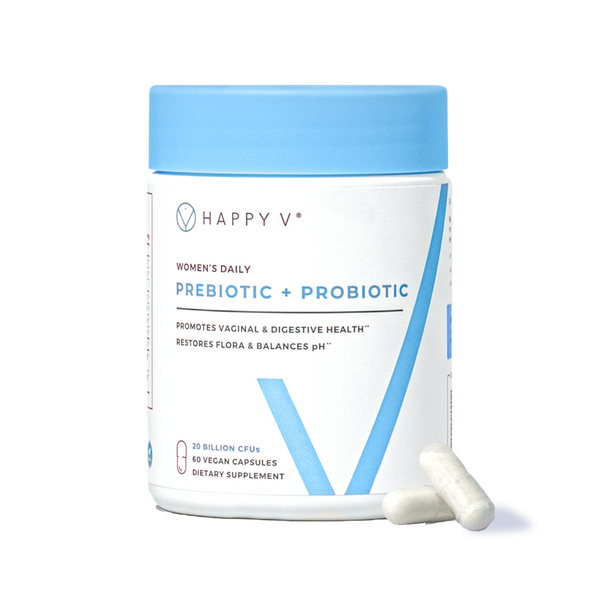
Happy V's Prebiotic + Probiotic contains specific probiotic strains selected for women's health. What factors go into selecting those strains?

L: For probiotics, strain specificity is key. Two strains within the same species can behave very differently, so we start by selecting strains that have been studied in clinical trials specifically for vaginal and urinary health.
We then evaluate whether those strains can survive the gastrointestinal tract and reach the site where they are intended to function, support a Lactobacillus-dominant microbiome, and have a strong safety profile. We also look closely at the clinical evidence to ensure the effective dose used in research is one that can realistically be delivered in the finished product.
There are so many buzzwords on supplement packaging today. Which certifications or third-party verifications actually matter, and what do they tell consumers about a product?
L: The certifications I pay the most attention to are those backed by independent, third-party organizations. For example, a product manufactured in a facility that complies with FDA current Good Manufacturing Practices (cGMPs) is a great sign. Certifications like USP Verified and NSF provide another level of confidence by evaluating things like ingredient identity, purity, potency, and, depending on the certification, whether the product meets its label claims.
On the other hand, claims like “clinically proven” without supporting references or “pharmaceutical grade,” which isn't a defined regulatory term for dietary supplements, don’t tell me much on their own about product quality. What matters most is whether the product has been independently evaluated and whether the company is transparent about how it's manufactured and tested.
What questions should women ask before deciding whether a supplement is right for them?
L: I always encourage people to start by asking, “What am I trying to support, and is a supplement the right tool for that?” Supplements are meant to complement a healthy diet and lifestyle; they're not a substitute for medical care. If you're experiencing new or persistent symptoms, it's important to talk with a healthcare provider to understand the underlying cause.
Once you've answered that, it's worth asking whether there's human clinical research supporting the ingredient for that specific use, and whether the dose matches what was studied. Certain life stages like pregnancy, breastfeeding, and hormonal transitions like perimenopause can all change what's appropriate or safe. If you're taking medications or have an underlying health condition, it's also a good idea to talk with your healthcare provider about any potential drug-nutrient interactions.
Finally, be cautious of products that rely on fear or make promises that sound too good to be true. Quality supplements should be backed by science, not urgency.
How has your job changed the way you approach your own health and wellness?
L: Working at Happy V has definitely made me more intentional about my own health. When you spend that much time in the research on the vaginal and gut microbiome, urinary health, and women's nutrition, you start to see how connected all of it actually is and how important it is to take care of it. I've also learned a lot about how dietary supplements are developed and manufactured. That includes evaluating ingredients and clinical evidence, but also understanding quality standards and label transparency. It's made me a lot more careful about what I choose to take.

As someone who reviews scientific literature and compliance guidelines every day, what's one misconception you wish more people understood about dietary supplements?
L: One misconception is that dietary supplements are all the same and that you can evaluate one just on the claims on the front of the bottle. In practice, that's not always the case. Two products can look nearly identical yet differ in ingredient quality, dose, supporting research, and how they're formulated and manufactured. That's why I recommend looking past the marketing and asking what's actually in the product, whether there’s good evidence behind it, and whether the company is transparent about how it's made.
What excites you most about the future of women's health research, and where do you hope to see more innovation or investment in the years ahead?
L: I'm excited to see women's health finally getting the research attention it deserves, particularly when it comes to the vaginal microbiome. For a long time, it's been studied far less than the gut microbiome, but that's starting to change. We're learning much more about what supports a healthy, Lactobacillus-dominant environment, and how different probiotic strains may contribute in different ways.
Looking ahead, I'd love to see more research designed specifically for women instead of just applying findings from studies that were mostly done on men. We also need more studies across different hormonal life stages, especially postpartum and perimenopause, where there are still many unanswered questions. I'm especially interested in seeing more research on the connection between the gut and vaginal microbiomes, since we're really only starting to understand how those systems influence each other.
Keep the Conversation Going
-
Shop evidence-based probiotics that meet all Lenia’s supplement standards.
-
Visit our blog for more interviews and women's health tips.
-
Join our private Happy V Facebook group to hear from others who've been there.
Disclaimer: This blog is for informational and educational purposes only and is not intended to diagnose, treat, cure, or prevent any disease. Statements about supplements have not been evaluated by the Food and Drug Administration. For more information about vaginal infections, visit the CDC or speak to a licensed healthcare provider.
Our experts continually monitor the health and wellness space, and we update our articles when new information becomes available.
- Published on: August 28, 2026
- Last updates: August 28, 2026
Written by Daniella Levy
Edited by Liz Breen