


- Fact Checked
- May 22, 2026
- 5 min read
Wellness Unfiltered with Dr. Tara Shirazian, MD: An OB-GYN’s Perspective on BV and Women’s Health Misinformation

-
Written by
Hans Graubard
• Updated on May 22, 2026

Dietary supplement manufacturing, regulatory and product development, and DTCt; leadership experience...
- Updated on May 22, 2026
Table of Contents
Table of Contents
For many women, BV feels like a complete (and totally frustrating) mystery. Symptoms come and go, treatments often feel temporary, and advice online often oversimplifies what’s actually happening in the body.
That’s why we created Wellness Unfiltered, a monthly interview series that cuts through the noise by sharing honest, nuanced conversations with experts in women’s health, medicine, and education.
For this edition, we spoke with Dr. Tara Shirazian, MD, an OB-GYN, surgeon, researcher, and founder of NYU Langone’s Center for Fibroid Care. Alongside her clinical work, she also leads global women’s health initiatives through her nonprofit, Saving Mothers, and hosts the podcast Health Starts with Her, where she explores women’s health through patient stories and expert conversations.
In her interview with us, Dr. Shirazian breaks down what BV actually is, why some women are more prone to recurring imbalance, how lifestyle and hormonal shifts can affect vaginal health, and why misinformation on social media is making women’s health harder to navigate, not easier.
This post is for informational purposes only and does not constitute medical advice. See full disclaimer below.
10 Questions for Dr. Tara Shirazian, MD
1. Can you introduce yourself and share a bit about your background and what led you to specialize in women’s health, specifically as an OB-GYN?
T: I’m Dr. Tara Shirazian. I’m an OB-GYN who cares deeply about improving women’s health care- access, delivery, and education. I founded and run a center for fibroid care for NYU Langone, and a non-profit for global women’s health outreach called Saving Mothers.

I have always thought that women’s health was the field for me. I enjoy educating and empowering women, offering guidance and medical management in extremely vulnerable times of their lives. As a surgeon, I especially love being able to have the tools and expertise to solve their surgical issues, help them with pain, improve their quality of life, and help them achieve their family goals.
2. What does a typical day in your life as an OB-GYN look like, and what are the most rewarding and hardest parts of your job?
T: No 2 days are ever the same!
I spend time in the office seeing women from across the country, I operate at NYU Langone, and I host a podcast called Health Starts with Her on YouTube. I also do research and have 4 ongoing research studies currently and teach medical students and residents. I run a non-profit called Saving Mothers and do global health outreach for women in remote areas where there’s no access to care.
3. One of our most asked questions from our community is “What is BV?” At a foundational level, how do you explain what Bacterial Vaginosis (BV) is to patients?
T: Bacterial vaginosis is a common, benign overgrowth of mixed types of bacteria in the vagina.
4. What typically causes BV in the first place, and why are some women more prone to it than others?
T: The healthy vaginal pH is disrupted, and there is overgrowth of a mixed bacterial picture representing BV.
5. Why do so many women get stuck in the BV → yeast infection → BV cycle? What’s actually happening in the body during that loop?

T: Many things can create this BV cycle, including anything that disrupts your vaginal pH, products you use that change pH, excessive bleeding, and a partner that carries BV, which is why partner treatment has recently been shown to break the BV cycle for many women who have a male partner.
6. Outside of your work, what does your version of “wellness” actually look like?
T: Wellness is sleep, exercise, a good diet, and doing the things you love to reduce stress and feel good about yourself.
7. What are things patients often hold back from asking or sharing, and how can they better advocate for themselves in a gynecologist’s office?

T: I think they may feel embarrassed in some gynecologist offices to discuss their periods, vaginal discharge, or sexual health issues. Writing down questions and coming prepared to address issues can help. Also, bringing a friend or family member can help.
8. For women dealing with hormonal shifts (cycle changes, PMOS, coming off birth control), what changes in vaginal health should they actually be paying attention to?
T: Changes in discharge and changes in menstrual cycling.
9. From your perspective, what lifestyle factors impact vaginal health most?
T: Diet, exercise, and sexual partners.
10. Do you feel like conversations, research, and resources around women’s health are actually improving or do we still have work to do?
T: I think social media has made misinformation worse, and women’s health education is suffering. Health care has been reduced to 30-second social media clips, and the reality is far more complex and nuanced.
On my YouTube podcast Health Starts with Her, I aim to demystify gynecologic health through patient stories and honest conversations. I have frank conversations with women, influencers, and physicians on all topics in women’s and gynecologic health. You can follow the conversation at @drshirazian or @healthstartswithher.
Keep the Conversation Going
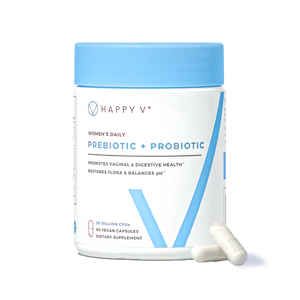
- Shop evidence-based probiotics that focus on long-term balance (not quick fixes)
- Explore more Expert Interviews featuring experts in women’s health, hormones, and the microbiome.
- Join our Happy V community to connect with other women navigating similar health experiences.
Disclaimer: This blog is for informational and educational purposes only and is not intended to diagnose, treat, cure, or prevent any disease. Statements about supplements have not been evaluated by the Food and Drug Administration. For medical concerns, consult a licensed healthcare provider.
FAQ
What are the signs that your pH balance is off?
Can a man throw off your pH balance?
Can stress throw off your vaginal pH?
How long does it take for vaginal pH to return to normal?
Does Happy V® Prebiotic + Probiotic help with bacterial vaginosis (BV)?
Our experts continually monitor the health and wellness space, and we update our articles when new information becomes available.
- Published on: May 22, 2026
- Last updates: May 22, 2026
Written by Hans Graubard
Edited by Liz Breen