

- Fact Checked
- May 19, 2026
- 15 min read
Can Probiotics Cause Yeast Infections? What You Need to Know

- Written by Daniella Levy • Updated on May 27, 2026
- Updated on May 27, 2026

Table of Contents
Table of Contents
If you've started taking a probiotic for vaginal health and suddenly noticed some unusual symptoms like itching and cottage cheese-like discharge, you may be wondering if your new wellness routine could be making things worse and actually causing the infections you’re looking to avoid.
While definitely normal to wonder, the science is clear: probiotics do not cause yeast infections. In fact, the right probiotics actively work to prevent them. But how do they do that? And what makes a probiotic the “right” probiotic, anyway? That’s exactly what we’re here to discuss. By the end of this article, you’ll understand what probiotics are, how they work inside your body, and how to shop smarter when it comes to these popular supplements.
This post is for informational purposes only and does not constitute medical advice. See full disclaimer below.
What Are Probiotics?
To understand why probiotics don't cause yeast infections, it helps to understand what probiotics actually are.
Probiotics are live beneficial bacteria. Think of them as reinforcements for the good bacteria already living in your body. When you take them, these live microorganisms crowd out harmful microorganisms, support your natural flora, and help key body systems (including digestive and reproductive systems) work the way they should.1
The most well-researched probiotic strains for gut and vaginal health belong to the Lactobacillus and Bifidobacterium genera.2 These probiotics have been shown in clinical studies to help:
- Maintain a healthy vaginal microbiome. Specific Lactobacillus strains produce lactic acid that keeps vaginal pH low and Candida (aka the main fungus behind yeast infections) in check
- Support gut microbiome balance. These beneficial bacteria crowd out harmful microorganisms, support nutrient absorption, and protect the gut lining
- Prevent infections. A well-populated microbiome leaves less room for Candida, harmful bacteria, and other pathogens to take hold3
But their benefits don't stop there. Specific strains of Lactobacillus and Bifidobacterium also help regulate inflammation tied to skin conditions like acne and eczema, support the production of antibodies and immune cells, and influence mood and stress response through neurotransmitter production via the gut-brain axis.4
We’ll get into what those strains are in a bit, but for now, know that not all probiotic strains work the same way. Different strains do different jobs, which is exactly why strain specificity matters when choosing a probiotic for vaginal health specifically.5
What are Yeast Infections?
So we’ve covered what a probiotic is and how it functions in your body. Now, let’s talk about what a yeast infection is, not just in terms of symptoms but what’s happening on a microscopic level that’s leading to those symptoms.6
Vaginal yeast infections occur when Candida (most often Candida albicans) overgrows and overtakes the vaginal microbiome.
Now, even healthy vaginas contain some Candida, but healthy vaginas also have enough beneficial bacteria (aka Lactobacillus probiotics) to keep its growth under control. When something causes the levels of protective Lactoacillus to drop, that’s where the trouble occurs. In these conditions, Candida can proliferate rapidly, leading to hallmark symptoms of a yeast infection like thick white discharge (often described as cottage cheese-like), vaginal itching, irritation, and pain during urination or intercourse.7
Most women experience one yeast infection in their life, but some women experience them on a recurrent basis (meaning three or more yeast infections per year). Recurrent infections are often tied to ongoing triggers that chronically disrupt vaginal flora.8
Common triggers that disrupt vaginal flora and invite Candida overgrowth include:
- Antibiotic use. Antibiotics kill off Lactobacillus alongside harmful bacteria, stripping the vaginal flora of the beneficial competition that keeps Candida in check.9 Recurrent infections after antibiotic courses are extremely common for this reason.
- Hormonal changes. Estrogen and progesterone fluctuations tied to menstrual cycles, pregnancy, and hormonal contraceptives all alter vaginal pH and shift vaginal flora.10 Hormonal contraceptives in particular can raise glycogen levels in vaginal tissue, which Candida feeds on. Hormonal changes at perimenopause also increase vulnerability.
- Elevated blood sugar levels. Candida feeds on sugar. People with diabetes, and especially unmanaged diabetes, are at significantly higher risk for recurrent infections because chronically elevated blood sugar levels create a favorable environment for Candida overgrowth in the vaginal flora and gut.11
- A weakened immune system. A weakened immune system, whether from illness, chronic stress, certain medications, or autoimmune conditions, reduces the immune cells and antibodies that patrol for and suppress Candida.12 People with a weakened immune system experience recurrent infections far more often because Candida overgrowth goes unchecked.
- Pregnancy. Hormonal changes and elevated blood sugar levels during pregnancy both shift vaginal flora and create conditions where Candida overgrowth is more likely. This is why yeast infections are among the most common vaginal health issues during pregnancy.13
- Diet high in refined sugars and processed foods. Refined sugars directly feed Candida in both the gut and vaginal flora, while processed foods reduce the diversity of gut bacteria that compete with it.14
- Stress. Chronic stress suppresses immune function, elevates blood sugar levels, disrupts gut microbiome balance, and weakens the vaginal flora's resilience to Candida overgrowth.15
Note what's not on that list: taking probiotics. That’s because probiotics belong on a different list, one not of Candida triggers but Candida deterrents.
But What About Those Symptoms You Noticed?
Probiotics don’t cause yeast infections. In fact, they support the conditions that prevent Candida overgrowth.
While that’s the science, we aren’t denying that some people do experience new symptoms when taking probiotics. Here’s what actually might be going on:
- You're in an adjustment period. Bloating, digestive discomfort, or mild changes in vaginal discharge in the first one to two weeks of taking probiotics are common side effects of microbial adjustment, not signs of a yeast infection.16 These side effects typically resolve on their own.
- You may have the wrong strains. A probiotic formulated for digestive health won't do much for your vaginal microbiome if it doesn't include the right Lactobacillus strains (which you’ll find down below).17 It won't cause a yeast infection, but it won't prevent one, either. So while the wrong strains might not be doing any actual harm, they also aren’t helping you meet your wellness goals.
- You may have a coincidental infection. Yeast infections are extremely common. If you started a probiotic around the same time symptoms appeared, the timing may be coincidental, triggered by antibiotics, hormonal changes, stress, or diet rather than anything your probiotic did.18
- You have a weakened immune system. For most healthy people, probiotics are safe and well-tolerated. Those with weakened immune systems due to underlying health conditions or certain medications should consult a healthcare provider before starting, as introducing live microorganisms is worth discussing when underlying health conditions are present.19
The Gut-Vagina Connection: Why Yeast Infections Often Start in Your Gut
So if probiotics aren't causing your yeast infection, what is? We listed several triggers that need to be considered, but there is something much larger to consider, too: your gut.
Gut microbiome balance is a central (and often overlooked) factor in yeast infection risk.20 Most people think of yeast infections as a localized vaginal problem, but Candida overgrowth frequently originates in the gut and spreads from there.
Your gut is home to trillions of bacteria, and when that community is diverse and thriving, those bacteria actively work to keep Candida from gaining a foothold.21 They compete with it for space, produce compounds that fight fungal growth, and help regulate the immune cells that patrol for infection.
But when that bacterial community gets thrown off balance (a state called dysbiosis), those protections disappear.22 The gut lining becomes more permeable, meaning Candida can cross it and spread to other parts of the body, including the vaginal microbiome. Immune function drops. Nutrient absorption suffers. Inflammation rises. All of that creates the exact conditions Candida needs to thrive.23
What throws the gut off balance? The same usual suspects we called out earlier: antibiotics, refined sugars, processed foods, chronic stress, and a diet that lacks the diversity needed to keep gut bacteria healthy over time. This is why gut health isn't just a digestion issue; it's directly tied to your vaginal wellness too.
The good news: a well-formulated probiotic is designed specifically to restore that balance.
And the benefits of restoring that balance go well beyond yeast infection prevention. A healthy, diverse gut is the foundation of whole-body wellness. Here's why:
- Your gut is where roughly 70% of your immune cells live. When your gut microbiome is thriving, your body produces more antibodies and immune cells, making you more resilient to infection overall. When it's not, your immune defenses take a hit.
- Your gut also talks directly to your brain. Through what's called the gut-brain axis, gut bacteria influence the production of neurotransmitters like serotonin, which means a balanced gut microbiome can positively affect your mood, focus, and stress response.
- A healthy gut lining is essential for absorbing the nutrients from your food. When the gut lining becomes permeable, your body can't absorb vitamins and minerals properly, even if you're eating well. And when inflammation goes unchecked (a common consequence of dysbiosis), the effects ripple outward to skin conditions like acne and eczema, hormonal disruption, and increased susceptibility to infection.
The bottom line: taking care of your gut microbiome is one of the best things you can do for your overall wellness. Full stop. Probiotics are one powerful way you can do that… if you know how to choose the right ones.
Choosing the Right Probiotics for Gut and Vaginal Health
Now that you know probiotics can help, the next question is how to choose the ones that actually will. Not all probiotics are created equal, and when it comes to vaginal health specifically, the strain matters more than the brand name or the CFU count on the label.
Strain Specificity: What to Look For
Think of probiotic strains like different tools in a toolbox. Each one does a specific job. For vaginal health, you want strains that have been clinically studied for that purpose.
Look for supplements that include strains like:
- Lactobacillus rhamnosus GR-1, one of the most studied strains for recurrent yeast infections and bacterial vaginosis; look for "GR-1" specifically on the label
- Lactobacillus reuteri RC-14, aka the clinical partner to L. rhamnosus GR-1; the two are frequently studied together and work synergistically for vaginal health
- Lactobacillus rhamnosus HN001. This strain has been shown in clinical studies to significantly improve cure and recurrence rates for vaginal infections; also studied for mood and stress benefits through the gut-brain axis
- Lactobacillus acidophilus LA-14. Frequently paired with L. rhamnosus HN001 in research, the combination has been shown to inhibit pathogens responsible for both bacterial vaginosis and yeast infections, and to colonize the vaginal tract when taken orally
A quality supplement will list strains by their full name and designation, not just "Lactobacillus" as a genus. If the label is vague (think: proprietary blend), that's a red flag. See our guide on how to know if your probiotics are working to evaluate what you're currently taking.
Dosage and How to Take Them
Most clinical research on vaginal health uses formulations in the range of 1–10 billion CFUs. More important than hitting a high number, though, is taking your probiotic consistently. Daily use is what builds and maintains microbiome balance over time.
Always follow the recommended amounts on your supplement's label, as these vary by strain and formulation. More isn't always better, and exceeding recommended dosages is more likely to cause digestive discomfort than actually provide relief.
One more thing: pair your probiotic with prebiotics. Prebiotics (found in garlic, onions, bananas, and whole grains) essentially help those probiotics to colonize in your gut and vagina.
Other Things to Keep in Mind
For most people, taking probiotics is straightforward and well-tolerated. To give your probiotics the best chance of actually working:
- Read the label carefully. Look for transparent labeling with specific strain names and designations, CFU counts at expiration (not just at manufacture), and clear ingredient disclosure
- Be consistent. Probiotics require daily use to maintain gut microbiome balance and support natural flora; inconsistent use limits their effectiveness
- Stay hydrated. Hydration supports healthy gut motility and gut lining integrity, both of which help beneficial bacteria thrive
- Give it time. Mild digestive discomfort or changes in discharge in the first one to two weeks are normal as your microbiome adjusts; these side effects typically resolve on their own
If side effects like bloating or digestive discomfort persist beyond two weeks, it's worth checking in with a healthcare provider. It may simply mean a different strain or recommended amount is a better fit for your individual health needs.
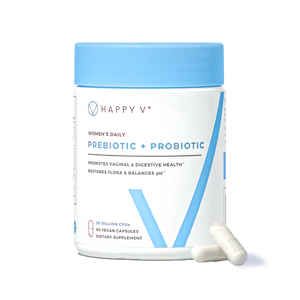
Start Here: Happy V's Prebiotic + Probiotic
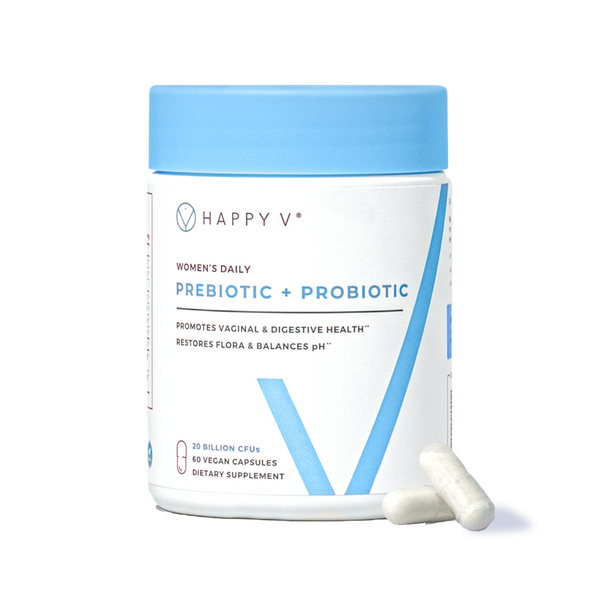
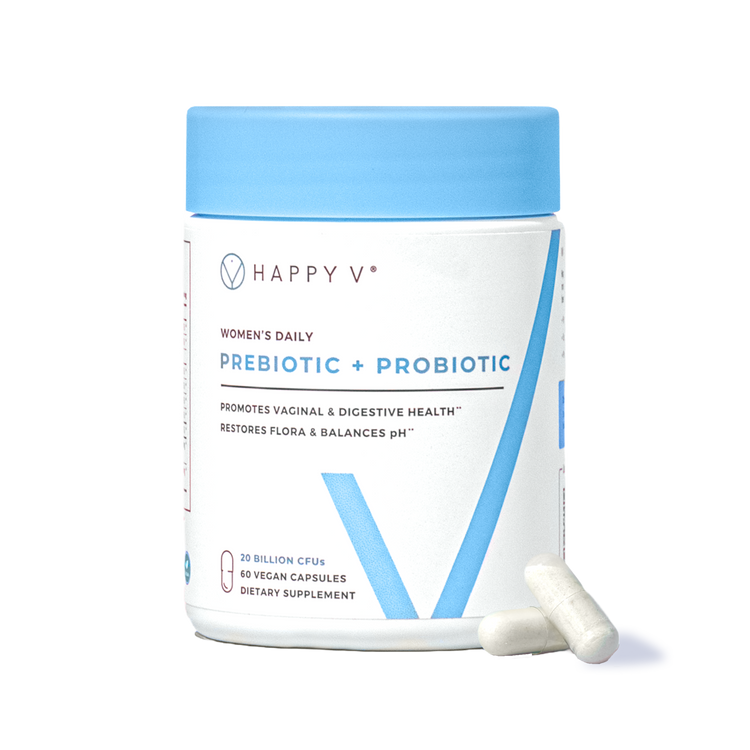
You now know what to look for in a probiotic: clinically studied strains listed by full name and designation, CFU counts at expiration, transparent labeling, and a formula that actually addresses vaginal health rather than just gut health generally. Happy V's Prebiotic + Probiotic checks every one of those boxes.
It's formulated with Lactobacillus strains specifically chosen for their ability to support Lactobacillus dominance in the vaginal microbiome and help maintain the slightly acidic vaginal pH that keeps infections from taking hold. And the proof isn't just in the individual ingredients! In a preclinical trial of Happy V's unique formula, our blend was shown to inhibit Candida growth, including Candida albicans, the strain responsible for the majority of vaginal yeast infections.
No proprietary blends. No vague ingredient lists. Just strains that have been studied, doses supported by research, and a formula designed with vaginal health as the goal, not an afterthought.
If you've been dealing with recurrent yeast infections, recently finished a course of antibiotics, or simply want to be more proactive about your vaginal wellness, Happy V’s Prebiotic + Probiotic is a straightforward place to start.
 Bestseller
Prebiotic + Probiotic
Maintains vaginal pH and restores gut health.
Other Strategies for Gut & Vaginal Health
Probiotics are a powerful starting point, but they work best as part of a broader approach. What you eat and how you manage stress both have a direct impact on your gut microbiome, which as we've covered, has a direct impact on your vaginal health. Here are two areas worth paying attention to.
Diet: Eat More of the Foods That Feed Good Bacteria
What you eat daily either feeds your beneficial bacteria or depletes them. A diet rich in prebiotic foods gives the good guys what they need to thrive. These include:
- Whole grains. Oats, barley, and brown rice supply the dietary fiber that beneficial bacteria ferment into compounds that support gut lining integrity and reduce gut permeability
- Garlic and onions. Both are rich in inulin, a prebiotic fiber that specifically feeds Lactobacillus and Bifidobacterium populations
- Bananas. Bananas, particularly slightly underripe ones, contain resistant starch that feeds beneficial bacteria without spiking blood sugar
- Fermented foods. Yogurt, kefir, and kimchi introduce live microorganisms directly and help maintain the diversity of gut bacteria
How to Increase Good Bacteria in Your Gut Naturally
How to Increase Good Bacteria in Your Gut Naturally (Without Overcomplicating It)
On the flip side, refined sugars and processed foods deplete the diversity of gut bacteria and directly feed Candida. Cutting back on both is one of the most impactful things you can do for your microbiome.
Stress Management: Take it Seriously
Chronic stress is one of the most underrated drivers of gut and vaginal health issues. Through the gut-brain axis, elevated cortisol reduces the diversity of gut bacteria, increases gut permeability, and weakens immune function, all of which create conditions where Candida can gain a foothold.
The good news is that even small, consistent habits make a difference. Yoga and meditation are among the most well-researched stress-relief techniques for supporting gut microbiome balance. Even 10–15 minutes a day adds up over time.
Breathwork and regular outdoor movement are worth building in, too, with the goal not being perfection, but finding stress-relief techniques that are simple and sustainable enough to actually stick.
When to Consult a Healthcare Provider
Many people can choose and manage probiotic use safely and effectively from home, but there are situations where it's worth looping in a healthcare provider, especially if:
- You have a weakened immune system or underlying health conditions that may affect how your body responds to live microorganisms
- You're getting recurrent yeast infections (three or more per year). This is often a sign of something else going on, like unmanaged blood sugar, hormonal imbalances, or a chronically disrupted microbiome that needs more targeted support
- You're pregnant. Many probiotic strains are safe during pregnancy, but it's worth confirming the right ones with your OB or midwife
- You've tried antifungal medications, and your symptoms aren't clearing up. You may be dealing with BV, a non-Candida fungal strain, or another condition that needs a different approach
- You're experiencing side effects like persistent bloating or digestive discomfort beyond two weeks of starting a new supplement
Remember, when in doubt, it's always okay to ask. A healthcare provider can help you figure out whether a probiotic is the right tool, which strains make sense for your situation, and whether something else might be going on.
Keep the Conversation Going
- Visit our blog for more women's health tips.
- Join our private Happy V Facebook group to hear from others who've been there.
- Explore supplements designed to support your vaginal health journey.
Disclaimer: This blog is for informational and educational purposes only and is not intended to diagnose, treat, cure, or prevent any disease. Statements about supplements have not been evaluated by the Food and Drug Administration. For more information about vaginal infections, visit the CDC or speak to a licensed healthcare provider.